ADVERTISING: Week 08
24th May 2016 (Week 8)
Gabriella Godeliva Adytanthio (0324170)
Advertising Principles & Practice
Advertising Message and Choice of Media
Lecture
Advertising Message and Choice of Media
The Tuesday lecture started off with a statement: "Just as the advertising message can be creative, the choice of media can be creative too." This is followed by a definition of media, which is described as the main means of mass communication. We were introduced to two types of media that are used for advertising:
We then discussed media strategy. Media strategy is basically how to achieve the stated media objectives by determining which media will be used, where, how often and when it is "displayed". Media strategy is a process of analyzing and choosing media for a campaign. Here is where IMC (integrated marketing communication) comes in—it has to create effective media strategy in order to achieve the goal of communicating the advertising message. IMC is connected closely to media mix, and sometimes are mixed up (?) due to the language used by the people in the advertising industry. Media mix is defined as a combination of advertising channels employed in meeting the promotional objectives of a marketing plan or campaign.
IMC and media mix is different but same but different.
After Mr. Vinod showed us several good examples of ads, which media we have to identify/discuss, we were presented with a quote by Marshall McLuhan, philosopher of communication theory:
He means the medium influences how the message is perceived. This relates closely to the examples shown before the quote. To explain it so that it is easier to understand, Mr. Vinod uses the analogy of a well in the middle of the desert, and how that well can be the center of a village/town/human civilization. The well represents the medium, and the water the message. You cannot get water (message) without the well (medium), hence a symbiotic relationship is born.
I myself, finding a well in the desert not simple enough, think of it as a bowl of bakso—the bowl is the medium and the bakso is the message. I'm not sure if an entire human civilization can be built around a bowl of bakso, though.
A real-life example of "medium is message" was found in Bangsar (according to Mr. Vinod's story, I haven't seen it with my own eyes). It was a battery advertisement placed in the pillars supporting the highway. One of the pillars is covered with this picture of the battery. The message is that the battery is powerful, and the medium itself (the pillar supporting the highway) embeds itself in the message.
The factors in developing the media mix is mainly 5Ms:
Things I understood from this lecture:
Instructions
TIMeS weekly forum question:
In your own words, briefly explain the difference and similarities between Integrated Marketing Communications and Media Mix
Project 1 brief here
Submission
Project 3 brief here
Project 3 Submission
Research
Feedback
Specific Feedback:
The result of the misunderstanding we had in class about Project 3 is personally disappointing for me because that means that I spent a whole break doing something that is wrong. We ended up having to revise again, which is no big surprise, but at least not everything that we did is going to be thrown away.
The sketch discussion session we had on Tuesday was quite exciting, although I wasn't on top condition that day (sleepy and hungry as hell!). Nevertheless it was an informative experience since we get to see the progressions and results that everyone has.
Observation
I feel my spirit breaking: it's been a vicious cycle of work—show work—do more work for the past few weeks and somehow I'm just so tired and so down. My flu isn't helping with the already bad situation. I want this semester to end quickly, but that would just mean the next semester (that has 6 modules) will come around faster. I don't know. I'm just very, very tired.
Findings
I honestly don't know where all my motivation and rajin-ness and excitement went to (if I even had those in the first place). I don't know how to lift my spirits up.
Book of the week time (I'm not spirited enough to even put an exclamation mark). I borrowed a new book called Advertising is Dead: Long Live Advertising! by Tom Himpe. The first part of the book is called "Choosing techniques and media". The author talks about the four driving forces that all companies that wish to connect with consumers have in common:
1. Proximity, the amount of distance between brand and customer. "Companies want to get as close as possible to the point of purchase, to the moment of purchase, to the consumer's natural environment, to his or her inner circle". Mass media, as the bridge between brand as customer, has to satisfy two searches: 1) advertiser's search or a public and 2) public's search for entertainment.
There are two ways of reaching consumers:
1) the brand goes where people goes—the brand has to be mobile. This includes tactics like guerilla marketing. Guerilla ads have "the ability to penetrate places normally inaccessible to brands".
2) reverse tactic; to get up-close and personal with consumers, invite customers to step into your world. Let them interact witht the brand on their own terms.
As the author stated, basically proximity = "Your place or mine?"
2. Exclusivity, going where the competition is not. Brands are continuously looking for the where, when, and how they can enjoy people's devoted and undivided attention. Example: Mercedes Benz worked together with Ritz Carlton in their "Key to Luxury" campaign, where hotel guests were offered to the use of a Mercedes Benz car with unlimited mileage, a full tank of petrol each morning, and overnight valet parking. Imagine the same campaign but with more automobile brands joining in. It won't have the same impact as it is when it's only one brand.
"The less you have to share the attention of consumers with fellow advertisers, the more power you can exert over consumers."
Two more driving forces will be covered next week.
References
Himpe, T. (2008). Advertising is dead - long live advertising!. London: Thames & Hudson.
Picture credits
Figure 1
Personal documentation
Figure 2 — Advertising is Dead: Long Live Advertising!. (2016). Retrieved from http://ecx.images-amazon.com/images/I/51YoqZt3kpL._SX258_BO1,204,203,200_.jpg
Gabriella Godeliva Adytanthio (0324170)
Advertising Principles & Practice
Advertising Message and Choice of Media
Lecture
Advertising Message and Choice of Media
The Tuesday lecture started off with a statement: "Just as the advertising message can be creative, the choice of media can be creative too." This is followed by a definition of media, which is described as the main means of mass communication. We were introduced to two types of media that are used for advertising:
- MSM/Mainstream Media, some call them "traditional media" or "old media", but they all generally refer to television, newspapers, and radio. It is apparent that the consumption of mainstream media has been on decline.
- New media, which usually refers to online banners, YouTube ads, and online news portals. These are all available in the internet.
We then discussed media strategy. Media strategy is basically how to achieve the stated media objectives by determining which media will be used, where, how often and when it is "displayed". Media strategy is a process of analyzing and choosing media for a campaign. Here is where IMC (integrated marketing communication) comes in—it has to create effective media strategy in order to achieve the goal of communicating the advertising message. IMC is connected closely to media mix, and sometimes are mixed up (?) due to the language used by the people in the advertising industry. Media mix is defined as a combination of advertising channels employed in meeting the promotional objectives of a marketing plan or campaign.
IMC and media mix is different but same but different.
After Mr. Vinod showed us several good examples of ads, which media we have to identify/discuss, we were presented with a quote by Marshall McLuhan, philosopher of communication theory:
"The medium is the message."
He means the medium influences how the message is perceived. This relates closely to the examples shown before the quote. To explain it so that it is easier to understand, Mr. Vinod uses the analogy of a well in the middle of the desert, and how that well can be the center of a village/town/human civilization. The well represents the medium, and the water the message. You cannot get water (message) without the well (medium), hence a symbiotic relationship is born.
I myself, finding a well in the desert not simple enough, think of it as a bowl of bakso—the bowl is the medium and the bakso is the message. I'm not sure if an entire human civilization can be built around a bowl of bakso, though.
A real-life example of "medium is message" was found in Bangsar (according to Mr. Vinod's story, I haven't seen it with my own eyes). It was a battery advertisement placed in the pillars supporting the highway. One of the pillars is covered with this picture of the battery. The message is that the battery is powerful, and the medium itself (the pillar supporting the highway) embeds itself in the message.
The factors in developing the media mix is mainly 5Ms:
- Market, basically target audience
- Money, which means exactly what it is—budgets and the like
- Media, all communication channels that is available. Don't forget to consider the message of the ads when picking media!
- Mechanics, which includes stuff like size, style, timeslots of ads
- Methodology, refers to "the overall media strategy of selecting and scheduling media channels to achieve the desired message weight, reach, frequency, and continuity objectives"
Things I understood from this lecture:
- Media can also be creative like the ad message
- Streams of media
- IMC and media mix
- McLuhan's idea of "the medium is the message"
- 5Ms
IMC vs Media Mix
The lecture on Friday was quite short because Mr. Vinod had to go to a meeting. We discussed the question posted on TIMeS:
There is an apparent hierarchy difference between IMC and media mix: IMC is marketing, and media mix is a tool of advertising, which is in turn a tool of marketing. Marketing is the "umbrella".
After that we discussed some more about self-censorship and how we should practice it moderately in the correct time/occassion; after all, if everybody is playing safe, there will be nothing new. The issue of self-censoring yourself is always a hard question to crack. In this case, we might be self-censoring ourselves because of the nature of the product we're advertising. Condoms are an inseparable part of the sex topic, and it is considered a taboo in this country. Why is it a taboo if it is a natural part of being human?
In the end, regardless if you self-censor or not, you need to present the facts and present your understanding/how you see the case. Make people realize that your decisions are not baseless, and you made it with good reason.
If we all self-censor unnecessarily, then the new generation won't be much different from their predecessors.
The lecture on Friday was quite short because Mr. Vinod had to go to a meeting. We discussed the question posted on TIMeS:
In your own words, briefly explain the difference and similarities between Integrated Marketing Communications and Media MixThe similarities between IMC and media mix is they both communicate one message only. An effective campaign delivers only one message that is consistent throughout.
There is an apparent hierarchy difference between IMC and media mix: IMC is marketing, and media mix is a tool of advertising, which is in turn a tool of marketing. Marketing is the "umbrella".
After that we discussed some more about self-censorship and how we should practice it moderately in the correct time/occassion; after all, if everybody is playing safe, there will be nothing new. The issue of self-censoring yourself is always a hard question to crack. In this case, we might be self-censoring ourselves because of the nature of the product we're advertising. Condoms are an inseparable part of the sex topic, and it is considered a taboo in this country. Why is it a taboo if it is a natural part of being human?
In the end, regardless if you self-censor or not, you need to present the facts and present your understanding/how you see the case. Make people realize that your decisions are not baseless, and you made it with good reason.
If we all self-censor unnecessarily, then the new generation won't be much different from their predecessors.
Instructions
TIMeS weekly forum question:
In your own words, briefly explain the difference and similarities between Integrated Marketing Communications and Media Mix
Project 1 brief here
Submission
Project 3 brief here
Project 3 Submission
Research
 |
| Figure 1 — Last batch of sketches |
Feedback
Specific Feedback:
Presentation is populated with data that back up claims made. Good. The conclusion made in all stages were excellent. Comprehensive presentation. It would help to list down the number of media used and the number of ads for each media in the conclusion.
General Feedback:
(For first submission of Project 3)
Mr. Vinod mentioned how he had expected more after the feedback of Project 2, but it didn't turn out as he expected. First of all there was the misunderstanding of the number of media, in which almost everyone made a mistake.
Then there is the issue of citation; if a statement's basis is your own assumption, state "I assume" or "Based on my observation", etc. Relevance of data should also be considered—general data that comes from outside Malaysia can also be plausibly applied in Malaysia, but specific data (e.g. number of people clicking on a certain ad) coming from outside Malaysia cannot.
We also need to think of the media's feasibility by putting ourselves in our ad host's position, since we are expected to practice self-censorship in Malaysia. Put appropriate ad content in appropriate spaces if you don't want to get in trouble. Suggesting condoms to be promoted (given out) in universities will most likely be turned down. Focus on ads that are type and visual; we are allowed to do TV/cinema and radio, but only as last two options, considering the fact that we've only learnt to make ads that are more static.
Reflection
ExperienceThe result of the misunderstanding we had in class about Project 3 is personally disappointing for me because that means that I spent a whole break doing something that is wrong. We ended up having to revise again, which is no big surprise, but at least not everything that we did is going to be thrown away.
The sketch discussion session we had on Tuesday was quite exciting, although I wasn't on top condition that day (sleepy and hungry as hell!). Nevertheless it was an informative experience since we get to see the progressions and results that everyone has.
Observation
I feel my spirit breaking: it's been a vicious cycle of work—show work—do more work for the past few weeks and somehow I'm just so tired and so down. My flu isn't helping with the already bad situation. I want this semester to end quickly, but that would just mean the next semester (that has 6 modules) will come around faster. I don't know. I'm just very, very tired.
Findings
I honestly don't know where all my motivation and rajin-ness and excitement went to (if I even had those in the first place). I don't know how to lift my spirits up.
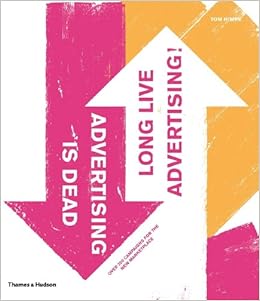 |
| Figure 2 — Advertising is Dead: Long Live Advertising! |
Book of the week time (I'm not spirited enough to even put an exclamation mark). I borrowed a new book called Advertising is Dead: Long Live Advertising! by Tom Himpe. The first part of the book is called "Choosing techniques and media". The author talks about the four driving forces that all companies that wish to connect with consumers have in common:
1. Proximity, the amount of distance between brand and customer. "Companies want to get as close as possible to the point of purchase, to the moment of purchase, to the consumer's natural environment, to his or her inner circle". Mass media, as the bridge between brand as customer, has to satisfy two searches: 1) advertiser's search or a public and 2) public's search for entertainment.
There are two ways of reaching consumers:
1) the brand goes where people goes—the brand has to be mobile. This includes tactics like guerilla marketing. Guerilla ads have "the ability to penetrate places normally inaccessible to brands".
2) reverse tactic; to get up-close and personal with consumers, invite customers to step into your world. Let them interact witht the brand on their own terms.
As the author stated, basically proximity = "Your place or mine?"
2. Exclusivity, going where the competition is not. Brands are continuously looking for the where, when, and how they can enjoy people's devoted and undivided attention. Example: Mercedes Benz worked together with Ritz Carlton in their "Key to Luxury" campaign, where hotel guests were offered to the use of a Mercedes Benz car with unlimited mileage, a full tank of petrol each morning, and overnight valet parking. Imagine the same campaign but with more automobile brands joining in. It won't have the same impact as it is when it's only one brand.
"The less you have to share the attention of consumers with fellow advertisers, the more power you can exert over consumers."
Two more driving forces will be covered next week.
References
Himpe, T. (2008). Advertising is dead - long live advertising!. London: Thames & Hudson.
Picture credits
Figure 1
Personal documentation
Figure 2 — Advertising is Dead: Long Live Advertising!. (2016). Retrieved from http://ecx.images-amazon.com/images/I/51YoqZt3kpL._SX258_BO1,204,203,200_.jpg